What Gold Karat Means for Your Payout: 10k vs 14k vs 18k vs 24k
Karat isn't a quality grade. It's a literal measurement of how much gold is actually in the metal — and it's the single biggest variable in your payout after weight itself.
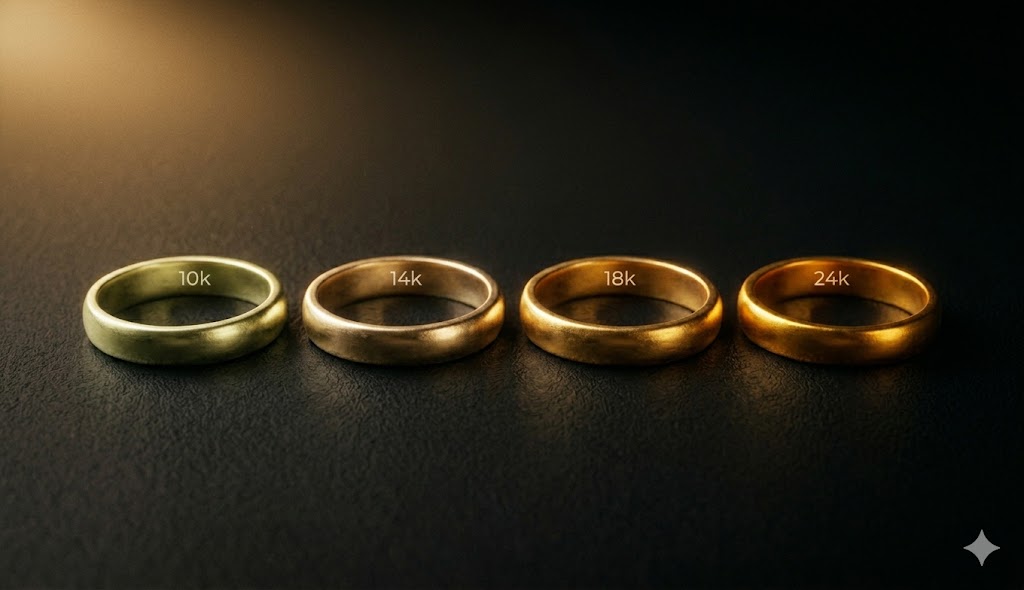
Two pieces of gold jewelry, both 10 grams, both walk into our shop on the same day. One is stamped 10k. The other is stamped 18k. The 18k piece pays almost twice as much. Why? Because karat isn't a quality grade — it's a literal measurement of how much gold is actually in the metal. Here's the math, the worked examples at every karat tier, and how to read the hallmarks before you walk in.
What karat actually measures
"Karat" is a fraction. The denominator is always 24. The numerator is how many parts out of 24 are pure gold. The rest is alloy — usually copper, silver, zinc, or nickel — added to make the metal harder and more durable. Pure gold is too soft for jewelry; you'd bend a 24k ring putting on a glove.
Convert karat to a decimal purity by dividing by 24:
- 10k = 10/24 = 41.7% pure gold
- 14k = 14/24 = 58.5% pure gold
- 18k = 18/24 = 75.0% pure gold
- 22k = 22/24 = 91.7% pure gold
- 24k = 24/24 = 99.9% pure gold (technically 99.95% in modern bullion)
This is the only number that matters when calculating what your gold is worth. A 10-gram 18k chain has 7.5 grams of pure gold. A 10-gram 10k chain has 4.17 grams of pure gold. The 18k chain is worth roughly 80% more on metal value alone — same weight, different purity, different paycheck.
The payout formula
To calculate what a dealer should pay you, run this:
(weight in grams) × (karat ÷ 24) × (spot price per gram) × (dealer payout percentage) = your payout
Spot is quoted per troy ounce, not per gram. To convert: divide spot per ounce by 31.1035. At today's $3,420/oz spot, gold is worth roughly $110.00 per gram of pure gold. Always check our live gold prices page for the current number — spot changes every few seconds during market hours. The mechanics behind that number are covered in how gold spot pricing actually works.
Today's math: 10g at every karat
Same 10-gram weight. Same dealer. Same 80% jewelry payout. Watch what karat does to the check:
10g 10k chain
- Pure gold: 10g × 0.417 = 4.17g
- Spot value: 4.17g × $110 = $458.70
- Payout at 80%: $366.96
10g 14k chain
- Pure gold: 10g × 0.585 = 5.85g
- Spot value: 5.85g × $110 = $643.50
- Payout at 80%: $514.80
10g 18k chain
- Pure gold: 10g × 0.750 = 7.50g
- Spot value: 7.50g × $110 = $825.00
- Payout at 80%: $660.00
10g 22k chain
- Pure gold: 10g × 0.917 = 9.17g
- Spot value: 9.17g × $110 = $1,008.70
- Payout at 80%: $806.96
10g 24k bar
- Pure gold: 10g × 0.999 = 9.99g
- Spot value: 9.99g × $110 = $1,098.90
- Payout at 96% (bullion-tier on .999 bars): $1,054.94
Same weight. The 22k pays more than 2× the 10k. The 24k bar pays nearly 3× the 10k chain because both purity AND payout percentage shift in your favor at bullion grade. Karat is the single biggest variable in the payout equation outside of weight itself.
Hallmark detective work
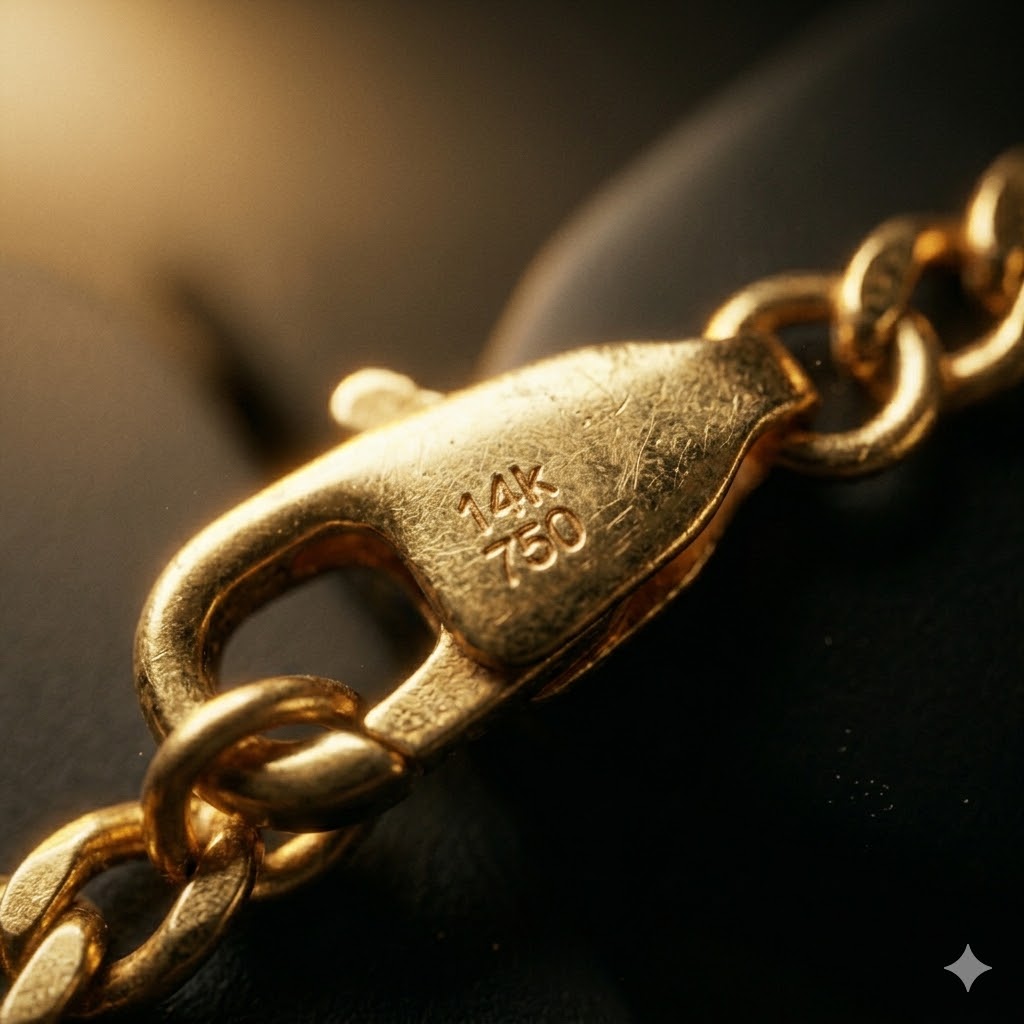
The first thing a dealer does is look for a stamp. Most jewelry has one, somewhere small and easy to miss: inside a ring band, on the clasp tongue of a chain, on the post of an earring, under the hinge of a bracelet. Common formats:
- "10K", "14K", "18K", "22K", "24K" — U.S. and most North American convention. Modern, plain.
- "417", "585", "750", "916", "999" — European thousandths convention (10k = 41.7% = "417"). Common on Italian, German, and most modern import jewelry.
- "22ct", "21ct" — Indian, Middle Eastern, Pakistani convention. "ct" is the older British-spelled karat.
- "GF", "GP", "GE", "1/20 12k GF" — gold-filled, gold-plated, gold-electroplated. These are not solid gold. They have a thin gold layer over a base metal core. Payout is essentially zero from a scrap standpoint — refining cost exceeds metal value on most plated items.
- "PLAT" or "950 Pt" — platinum, not gold. Different metal, different math, but valuable.
If a stamp is present, the dealer still verifies it. Three tools, in order of speed:
- Magnet test. Real gold isn't magnetic. If a piece sticks to a strong neodymium magnet, the core is steel or another base metal. This is the fast first-pass for spotting plated fakes.
- Acid test. A drop of nitric acid on a small scratch dissolves base metals but leaves gold intact. Different acid concentrations confirm different karat ranges. Quick, cheap, leaves a tiny visible mark on the back of the piece.
- Electronic / XRF tester. A handheld unit reads metal composition non-destructively. Slower than acid, but accurate to within a half-karat and works without scratching the piece. Most well-equipped dealers will run XRF on anything over a few grams or anything with an unusual stamp.
A dealer who tests in front of you isn't being suspicious — they're protecting both of you from a misquote. Plumb 14k stamped jewelry frequently tests at 13k or even lower. Old European pieces stamped "14k" sometimes test at 13.5 because of solder bleed-through. Testing is the only way to be sure.
What if my piece isn't stamped?
It's not unusual. Old jewelry sometimes loses the mark over decades of wear, the stamp may be on a section that was cut and re-soldered, or the piece may be from a country that didn't require hallmarking. Unstamped doesn't mean fake — it just means the dealer has to test from scratch.
What happens at the counter: the piece gets weighed, magnet-tested, then either acid-tested or XRF'd to determine actual purity. The dealer then prices based on the tested karat, not a guess. The trade-off: assay risk shifts entirely to the dealer, so unstamped pieces sometimes pay 2–3% lower percentage than stamped equivalents because the dealer can't fall back on the manufacturer's mark if the refinery comes back with a different number. Stamped 14k might pay 80%; unstamped tested-as-14k might pay 77–78%.
If you're considering pre-melting an unstamped piece to "simplify" the transaction, don't. A melted button with no provenance pays worse than the same metal in jewelry form, because the dealer has zero reference points and the refinery treats it as fully unknown.
Common karat mistakes (and how dealers spot them)
Five things that trip up sellers who haven't sold gold before:
- Asian gold isn't stamped Western. Indian, Pakistani, Bangladeshi, and Thai gold is typically 21k or 22k and stamped "916" or "21ct". A customer brings in a 22k bangle and assumes it's "fake" because there's no "K" in the stamp. It's not fake — it's higher purity than most U.S. jewelry. 22k pays a higher percentage of spot than 14k for both purity AND refining-ease reasons.
- "Plumb" 14k vs. unmarked 14k. "14kp" or "plumb 14k" means it's guaranteed at exactly 14k or higher (this used to be a U.S. legal distinction from older "commercial" 14k that ran 13.0–13.9). Dealers don't pay extra for plumb — the test is the test — but it's a good sign of newer manufacture.
- Gold-filled is often confused with solid gold. A piece marked "1/20 12k GF" is 1/20th by weight of a 12k gold layer over base metal. The total gold content is under 5% by mass. Old American watch chains and lockets are often gold-filled. They look real, weigh real, and pay essentially nothing.
- Class rings are usually 10k. If you have a high-school or college ring with no visible stamp, it's almost certainly 10k. The big stone (red, blue, green) has no scrap value — the gold around it does, but only the gold weight after the stone is removed.
- Two-tone chains pay different rates per section. A chain with white gold and yellow gold links is often two different karats — white gold sections might be 18k while yellow sections are 14k. A precise dealer will weigh each color separately. A rushed dealer averages everything down to the lower karat. Ask which method they're using.
Comparing your payout to spot
Once you know your karat and weight, you can calculate the theoretical max — 100% of spot on the pure gold content — and compare to what a dealer offers. Anything above 75% on standard jewelry is in fair-market range. Below 70%, ask why. Above 85%, you've found a dealer paying near-coin rates on jewelry, which is uncommon but happens with high-volume dealers who refine in-house.
Comparing two or three dealers on the same item is the single most reliable way to know you're getting fair pricing. The metal is identical; the percentage is negotiable. Comparing gold dealers takes 20 minutes and routinely surfaces 10–15% differences on the same lot.
Run the karat calculator
Enter weight and karat, see the full payout math at today's spot. Or call (213) 373-4424 for an over-the-phone estimate — we'll walk you through it before you drive over.
Run the calculator →What's a fair karat-payout percentage?
For 10k jewelry, fair is 68–76% of spot per gram of pure gold. For 14k, fair is 75–82%. For 18k, 78–85%. For 22k, 85–92%. For .999 bars or 24k bullion, 95–98%. Higher purity tightens the spread because refining is cheaper. Anything significantly below those bands without a clear reason (volatile market day, tiny lot, damaged piece, unstamped) deserves a second opinion.
Can I trust a hallmark stamp?
Mostly, but not always. Stamps from major manufacturers (Cartier, Tiffany, Bvlgari, modern Italian and U.S. brands) are reliable. Generic imports and very old pieces sometimes test below the stamped value — not because of fraud, but because of solder bleed-through, manufacturer tolerance, or wear. A dealer who tests in front of you is protecting both of you. If the test matches the stamp, you're paid on the stamp. If it tests lower, the dealer has to price on what's actually there.
Why is some 14k more yellow than other 14k?
Alloy composition. 14k gold is 58.5% gold and 41.5% mixed alloy. The mix changes the color: more copper makes it pinker (rose gold), more silver and zinc makes it paler yellow, more nickel or palladium makes it white. All three test at the same purity for scrap purposes. Color doesn't change the payout.
Is gold-filled the same as gold-plated?
Similar concept, very different gold content. Gold-filled (GF) has a thicker gold layer mechanically bonded to a base core — usually 1/10 or 1/20 of the total weight in 12k or 14k gold. Gold-plated (GP) has a microscopically thin gold layer applied electrochemically — less than 0.05% of total weight. Both pay essentially nothing on scrap because refining cost exceeds gold value. Sell them as costume jewelry on resale platforms instead.
Do you weigh stones, or just the metal?
Just the metal. If a stone is removable (most prong settings), the dealer pops it out, weighs the gold separately, and either returns the stone or evaluates it as a separate item. If the stone is bezel-set or otherwise hard to remove without damage, the dealer estimates the stone's weight and subtracts it from the total. For most colored stones, the math is simpler than it sounds — cubic zirconia, glass, garnets, and synthetic sapphires have negligible value and the dealer just discounts the gross weight by the estimated stone weight.
How does jewelry karat differ from coin karat?
Jewelry purity ranges from 9k to 24k depending on origin. Bullion coins cluster at 22k (American Gold Eagle, Krugerrand) or .999 (Canadian Maple Leaf, most modern bars). Same purity in coin form pays a higher percentage of spot than in jewelry form because coins are pre-refined and standardized. The full breakdown is in our jewelry vs. coins comparison.
What if my karat stamp is in a foreign convention I don't recognize?
Bring it in. Most stamps fall into a few patterns once you know what to look for: U.S. ("14K"), European thousandths ("585"), British ("14ct"), Indian/Middle Eastern ("916", "21ct"), Russian ("583" was Soviet 14k). A dealer who sees imports daily can usually identify the origin from the stamp style alone. The metal is the metal — the convention only matters for identifying it.
Karat is the multiplier on everything. Weigh your gold, identify the karat, divide karat by 24 to get the purity decimal, multiply that by the gram count, multiply by the per-gram spot price, then multiply by the dealer's payout percentage. The number you get should be within a few percent of any honest dealer's quote. If it's not, you have a clear basis to negotiate or walk.
If you want us to run the math on your specific pieces, call (213) 373-4424, or stop by our sell-gold counter with what you have. We'll weigh, test, and show you the karat-by-karat breakdown before you commit to anything. Compare it to our dealer comparison guide to see how we stack up. Prices subject to current spot. Calculations are illustrative.