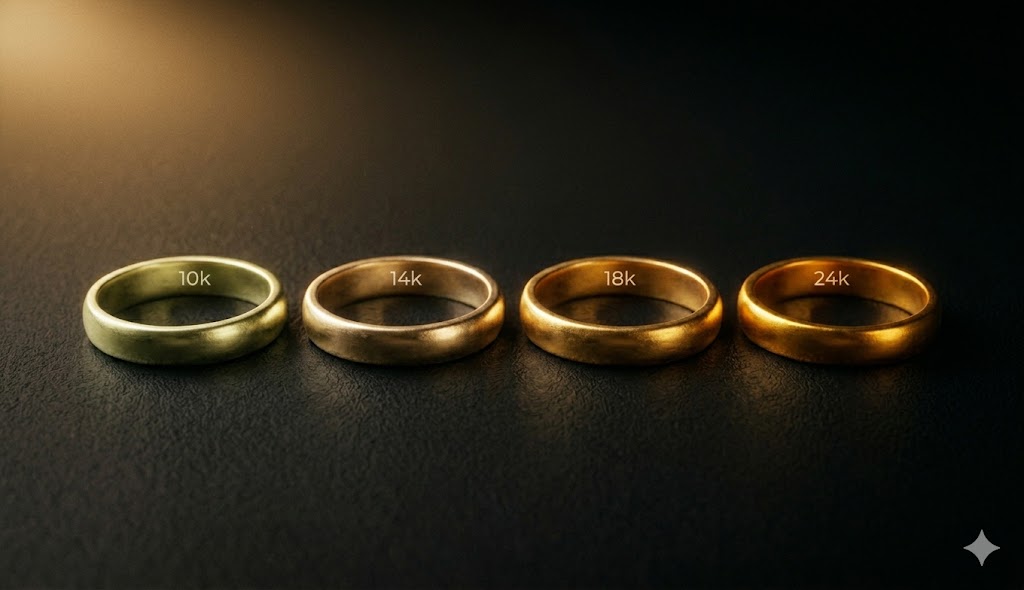
Selling Gold Jewelry vs. Gold Coins: Why Your Payout Differs
A 1oz American Eagle pays more than a 22-gram 14k chain — even though the chain weighs more. The reasons are concrete, and the math is the same at every honest dealer's counter.
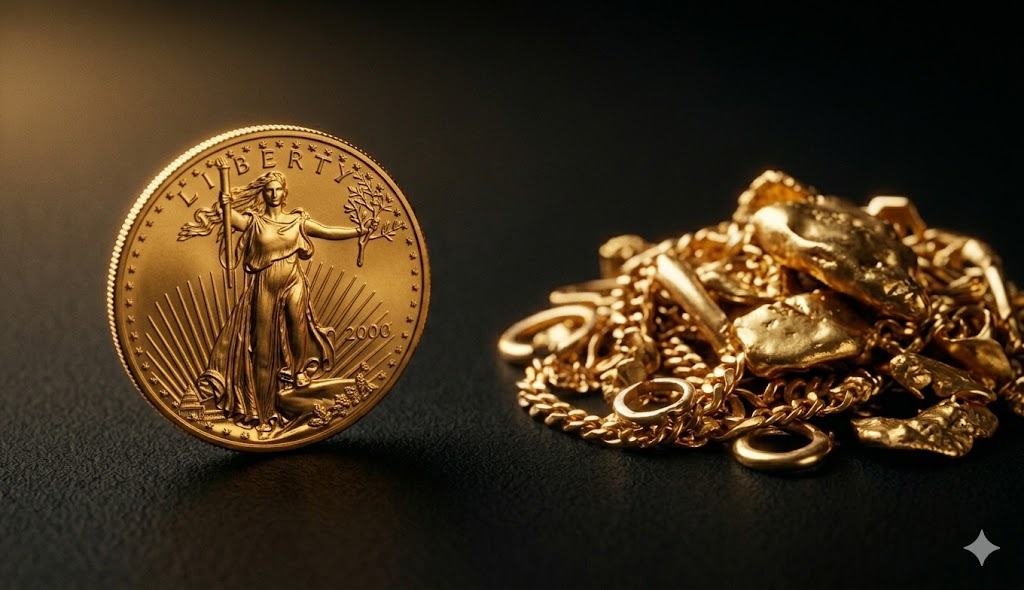
Two pieces of gold come across our counter on the same morning. The first: a 1-ounce American Gold Eagle. The second: a 22-gram 14k gold chain — heavier, by weight, than the coin. The chain owner expects more money. The coin owner walks out with the bigger check. Why? It comes down to two variables most sellers don't fully understand: purity and product premium. Here's the math, with current spot, so you can run it yourself before you walk in.
Start with what's actually in your hand
Gold weight is meaningless without purity. A 22-gram 14k chain isn't 22 grams of gold — it's 22 grams of metal, of which 58.5% is gold. A 1-ounce American Eagle isn't pure either, technically — it's 22-karat (91.67% gold), alloyed with copper for durability — but it's sold as a 1-troy-ounce gold coin because each coin contains exactly 1 troy ounce of gold (31.1 grams) plus the alloy weight on top.
So before any pricing math, here's what you actually have:
- 22-gram 14k chain: 22g × 0.585 = 12.87 grams of pure gold = 0.414 troy oz
- 1-oz American Eagle: exactly 1.0 troy ounce of pure gold = 31.1 grams
The coin contains 2.4× more pure gold than the heavier chain. That's the first reason the coin pays more.
Today's worked example
Numbers anchor everything. At today's $3,420/oz spot, run both items through a real dealer transaction:
1-oz American Gold Eagle:
- Pure gold value at spot: 1.0 oz × $3,420 = $3,420
- Numismatic premium (common-date): roughly $80 over melt
- Typical dealer payout on common gold coins: 96% of spot + small premium
- Your payout: ($3,420 × 0.96) + $80 = $3,500
22.4-gram 14k gold chain:
- Total weight: 22.4 grams
- 14k purity: 0.585 (58.5% gold)
- Pure gold content: 22.4g × 0.585 = 13.10g = 0.421 troy oz
- Pure gold value at spot: 0.421 oz × $3,420 = $1,440.04
- Typical dealer payout on 14k jewelry: 80% of spot
- Your payout: $1,440.04 × 0.80 ≈ $1,049
Same morning, same spot, same dealer. The coin pays roughly 3.3× the chain. The difference isn't dealer greed — it's the spread between what the market pays for refined, recognizable bullion vs. mixed-purity scrap. We break down the spread mechanics in how gold spot pricing actually works.
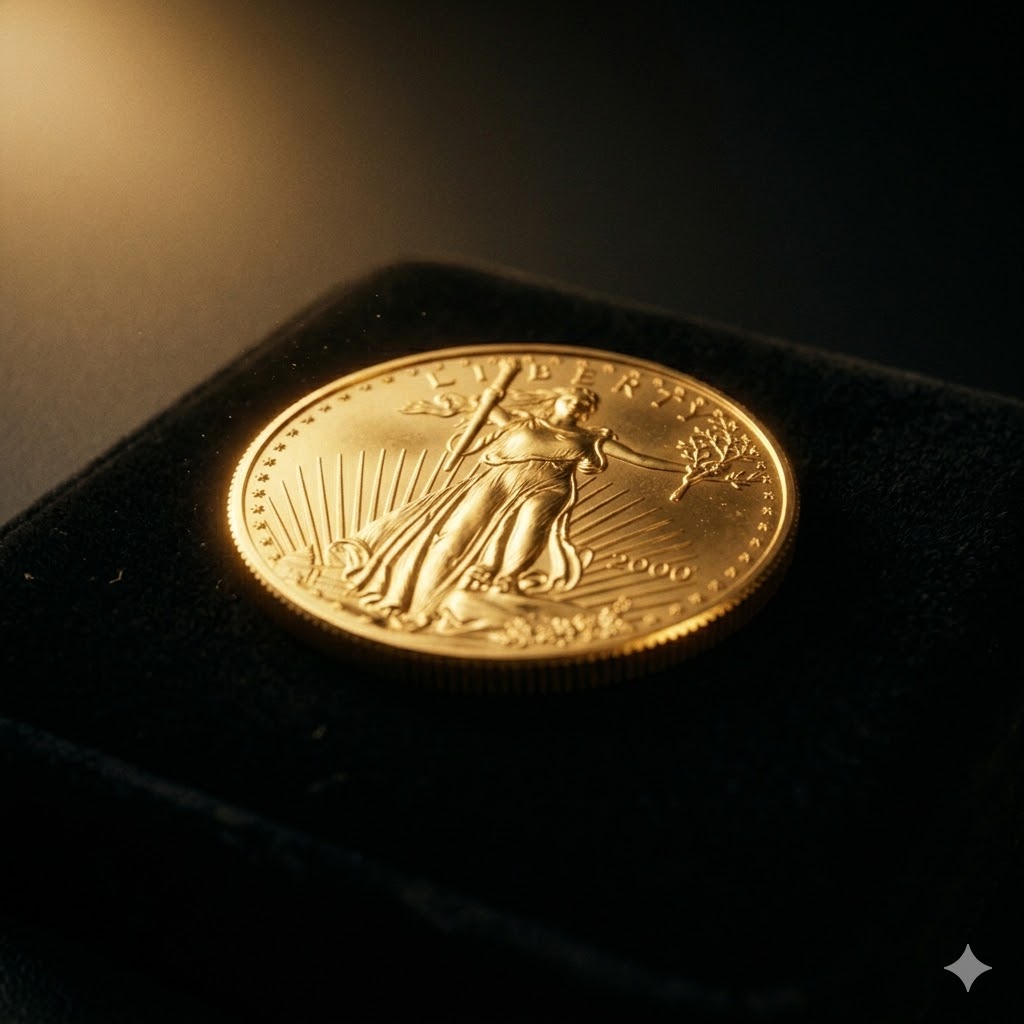
Why coins get paid closer to spot
An American Gold Eagle is fungible. Every dealer in North America recognizes it, every refinery accepts it, and the secondary wholesale market for it is liquid enough that a dealer can resell to another dealer at near-spot within hours. There's no refining cost, no assay risk (the coin is government-guaranteed for purity), no melt-and-separate step. The dealer's spread on a coin only has to cover float capital, overhead, and margin — typically 2–5% combined. Hence 95–98% of spot payouts.
The same logic applies, mostly, to other recognized bullion: Canadian Maple Leafs, South African Krugerrands, generic 1-oz bars from PAMP or Credit Suisse. The more standardized your gold, the closer to spot you get paid. Coins also carry small numismatic or product premiums that lift their payout slightly above pure metal value — a common-date Eagle pays $40–$100 over melt depending on demand.
Why jewelry takes a bigger discount
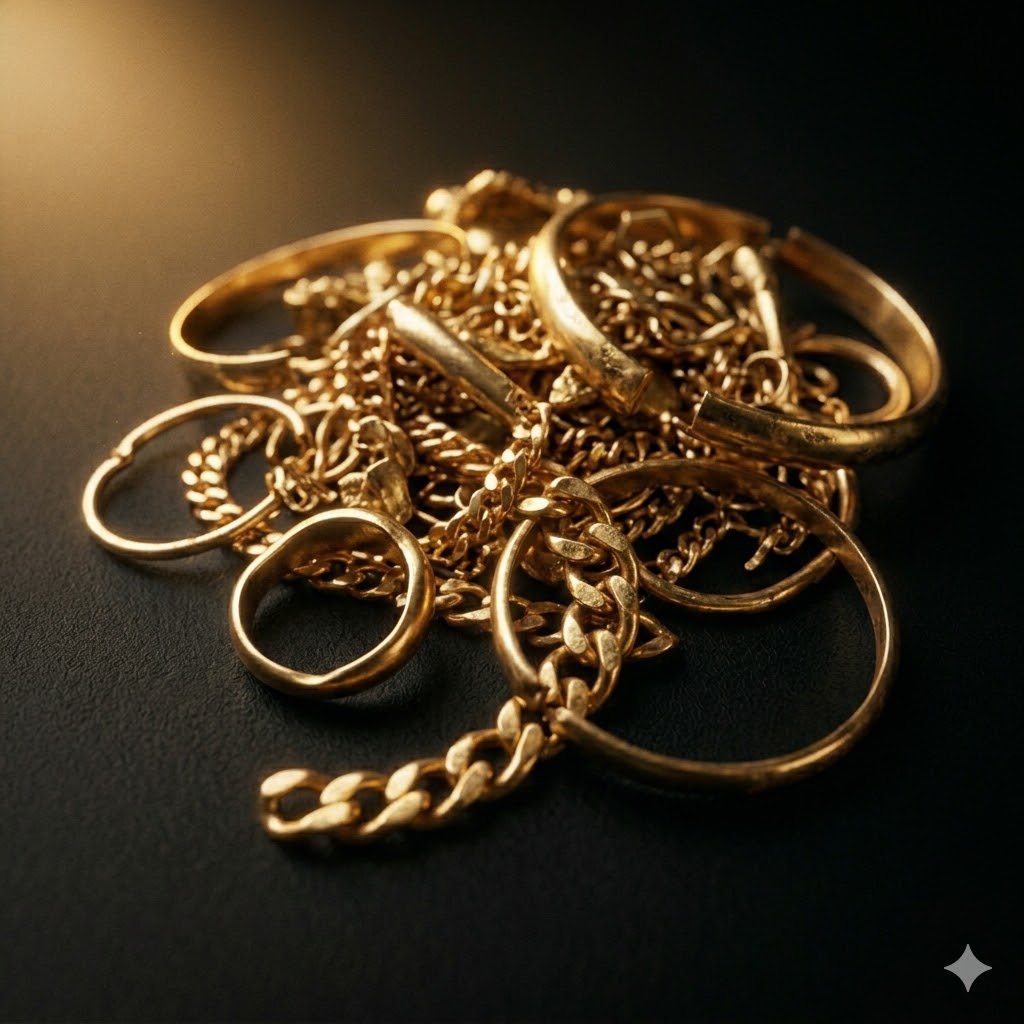
Jewelry is the opposite of standardized. Every chain, ring, and bracelet that crosses the counter has its own purity (10k, 14k, 18k, 22k, sometimes unmarked), its own alloy mix, and often its own settings (gemstones, enamel, solder joints) that need to be removed or accounted for. Before that gold is worth spot, it has to go to a refinery to be melted, assayed, and separated.
The dealer's spread on jewelry covers refining cost (typically 1–3% of metal value), assay risk (what if the karat stamp is wrong?), float window (7 to 30 days carrying spot price exposure), solder and findings (clasps and joints often have lower-purity solder that drags down the average), plus overhead and margin. Add it up and you get a 15–25% spread on jewelry vs. 2–5% on coins. That's why your 22-gram chain pays $1,049 instead of the $1,440 the math seems to promise.
Common counter scenarios
Three real situations that come through the door every week, and how each one gets priced:
Mixed lot, mixed karats. Customer brings in a 14k chain, a pair of 22k Indian bangles, and an 18k cocktail ring. Each piece gets weighed separately, tested separately (acid or XRF), and priced separately. The bangles pay closer to spot percentage-wise because 22k refines cleanly. The 14k chain pays the standard 78–82%. The ring with a center stone gets the gold weight calculated after the stone is accounted for. One transaction, three line items, one total check.
Inherited box of mismatched jewelry. Customer dumps out a bag — broken earrings, single rings, a tangled chain, a school ring with a colored stone, a few class pins. We sort by purity stamp first (10k, 14k, 18k piles), test the unmarked pieces, set aside anything plated or gold-filled (those pay essentially zero on scrap), and weigh each pile. The customer leaves with one number, but the math is per-pile. Sentimental pieces get pulled aside if the customer wants to keep them; we tell them honestly when something is worth keeping for non-scrap reasons.
Coin and jewelry combo. Customer has a Krugerrand and a 14k chain. Sell both in the same transaction. The coin anchors the deal at 96–97% of spot; the chain still pays the standard jewelry percentage but the dealer often tightens it slightly when there's a coin in the mix. One stop, one check, slightly better number on the jewelry side because of the bundled volume.
The spread, side by side
| Item | Weight | Purity | Spot Today | Dealer Payout | Premium / Discount |
|---|---|---|---|---|---|
| 1oz Gold Eagle | 33.9g (gross) | 22k | $3,420 | $3,500 | +$80 (numismatic) |
| 1oz Krugerrand | 33.9g (gross) | 22k | $3,420 | $3,317 | −3% (no premium) |
| 14k chain (heavy) | 22.4g | 14k (58.5%) | $1,440 | $1,049 | −27% (refining + assay) |
| 18k ring | 10g | 18k (75%) | $825 | $660 | −20% (cleaner refine) |
The pattern: higher purity means tighter spread because refining is cheaper. 18k pays a higher percentage of melt than 14k. 22k Indian and Middle Eastern jewelry often pays nearly bullion-level percentages.
What dealers wish you knew before walking in
Six things that come up at the counter every week, in dealer voice:
- Bring everything at once. Larger lots get tighter spreads. A 50-gram pile pays a higher percentage than three separate 15-gram visits because float and overhead are amortized across more metal.
- Don't clean it. Polished or buffed jewelry doesn't pay more — the dealer is paying for grams of pure gold, not cosmetics. Cleaning won't lift the quote and might damage stones.
- Know your stamps before you arrive. Look inside the band or near the clasp for "10K", "14K", "585", "750", "917". If you see "GF", "GP", "GE", or "1/20 12k GF" the piece is plated or filled and pays essentially nothing on scrap.
- Ask to see the math, not just the number. A fair dealer will write out: weight in grams × karat decimal × per-gram spot × payout percentage = your check. If they refuse to break it down, walk.
- Sentimental pieces deserve a separate conversation. If a piece has signed designer marks (Cartier, Tiffany, Bvlgari, David Yurman) or is a complete vintage estate piece, ask the dealer to evaluate retail value before scrapping. Some pieces are worth 3–10× melt to the right buyer.
- Same-day payment is normal. A licensed dealer pays cash or check at the counter. If a "buyer" wants to hold your gold overnight to "evaluate" or "wire funds tomorrow," that's a red flag, not standard practice.
The exception: collector or designer value
Most dealers — including us — pay scrap value on jewelry. That means we're pricing your gold based on what the metal alone is worth after refining. If your piece has collector value (signed Cartier, vintage Tiffany, certain estate pieces), an auction house or specialty buyer will pay more than scrap. We'll tell you when we see something like that and refer you out, because paying scrap on a piece worth retail is a disservice to the seller.
For most jewelry — generic chains, broken earrings, mismatched single rings, dental gold — scrap is the right pricing. If you're not sure, bring it in and ask. We'll tell you straight.
See what your jewelry is worth at today's spot
Karat × weight × today's spot, with our 80% payout shown openly. Run the math on our calculator or call (213) 373-4424 for a quote over the phone.
Run the calculator →Should I melt my chain or sell it whole?
Sell it whole. The dealer (or their refinery) handles melting. You don't get a higher price by pre-melting — if anything, an unmarked melted button raises assay risk and pays a worse percentage because the dealer has to test it from scratch with no karat stamp to verify against.
Why does my gold ring weigh more than its gold value?
Because it isn't pure gold. A 14k ring is 58.5% gold and 41.5% alloy (copper, silver, zinc, sometimes nickel). The alloy weight counts on the scale but pays nothing — refineries discard it. To estimate value, take your weight and multiply by the karat decimal (14k = 0.585, 18k = 0.75) before applying spot. For purity-by-purity math, see our karat payout breakdown.
Are pawn shops better than dealers?
Almost never, on payout. Pawn shops typically pay 40–60% of spot on jewelry because their business model assumes you might come back and redeem. Dedicated gold dealers pay 75–85% because they're buying outright for refining. If you're shopping around, get a quote from a licensed precious metals dealer before you accept a pawn quote — the gap is usually significant. Comparing dealers takes 20 minutes and routinely uncovers 20–30% better payouts.
Do I need to leave my jewelry overnight?
No. A licensed precious metals dealer weighs, tests, and pays at the counter, typically within 15–30 minutes of arrival. Larger lots (over $20,000) may need a brief verification call to confirm the funds source, but the metal stays in front of you the whole time. If a buyer wants you to leave the gold and "come back tomorrow," that's not standard.
Can I sell broken jewelry?
Yes, and broken jewelry pays the same as intact jewelry of the same purity and weight. Refiners melt everything regardless of condition. A broken clasp or a missing stone reduces total weight, but the gold that remains is priced normally. Don't pay to repair a piece you intend to sell — it won't lift the scrap price.
What about gemstones in my rings?
Gemstones in pieces sold for scrap are removed and either returned to the seller or held for a stone buyer's offer separately. The gold is weighed without the stone. If the stone is significant (over 1 carat for a diamond, or any quality colored stone), tell the dealer upfront so they can evaluate it on its own terms before pricing the gold for melt.
Does it matter where I sell — Los Angeles vs. online?
Local dealers and reputable online refineries pay similar percentages on standard scrap, but the math comes out differently after shipping insurance, transit time, and "evaluation" deductions. For under $5,000 in metal, local typically nets more. For larger lots, a direct refinery program (Garfield, Kitco, Manhattan Gold) can pay slightly higher percentages because they cut out the dealer middle-step. Always confirm payout percentage and any deductions in writing before shipping.
Gold coins pay more than gold jewelry of equal weight because coins contain more pure gold AND get sold at a smaller spread. Both factors compound. A 1-oz coin can pay 3× what a similarly-weighed jewelry piece pays — and that's not the dealer pocketing the difference, it's the cost of getting jewelry to a form a refinery will pay spot for.
Want a quote on what you have? Call us at (213) 373-4424, or run your gold through our jewelry calculator. We'll show you the math — purity calculation, today's spot, our payout percentage — before you commit to anything. If you want to think about it, take the numbers and shop them. That's how a fair market works. Prices subject to current spot. Calculations are illustrative.