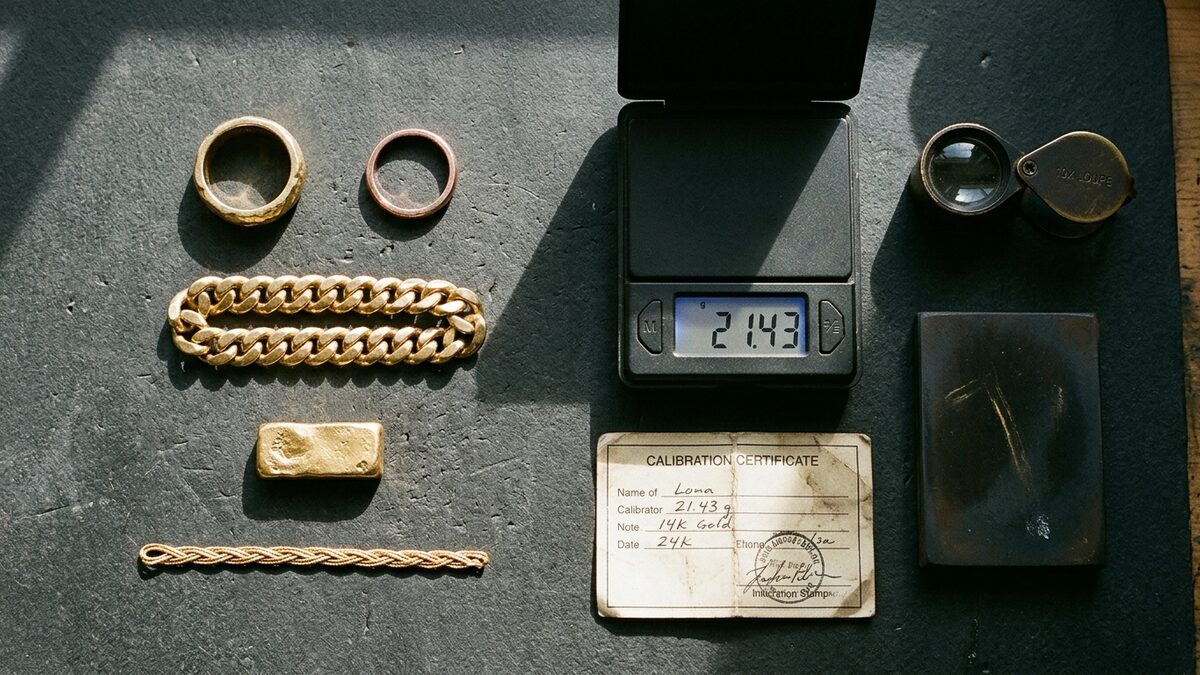
Gold karat is a measure of purity expressed in 24 parts. Pure gold is 24 karat, meaning 24 out of 24 parts are gold. Every karat number below 24 tells you how many parts gold and how many parts other metal (usually copper, silver, nickel, or zinc) are in the alloy. That ratio drives the payout, because dealers buy the gold content, not the jewelry.
The five karat tiers you will see most often in the United States are 10K, 14K, 18K, 22K, and 24K. Each carries a corresponding decimal stamp used internationally: 417, 585, 750, 916, and 999. If you see a three-digit number stamped on a piece, that is the same information written as a fineness, expressed in parts per thousand. A 14K ring and a 585 ring are identical in gold content.
10K gold is 41.7 percent pure. It is the legal minimum to be sold as gold in the United States, and it is common in class rings, low-cost chains, and older costume-grade jewelry. Because it is less than half gold by weight, the payout per gram is the lowest of the standard tiers. Sellers are often surprised by this, because the piece itself can feel substantial; the weight on the scale is mostly alloy.
14K gold is 58.5 percent pure and stamped 585. It is the most common karat in American jewelry, used for wedding bands, engagement settings, and everyday chains. Roughly 58 cents of every gram is gold, and that is the figure a dealer multiplies against the daily spot price to calculate the raw melt value.
18K gold is 75 percent pure, stamped 750. It is the standard for European fine jewelry and most luxury watch cases. The higher gold content gives it a richer yellow color and a noticeably softer feel. Three-quarters of every gram is payable gold, which is why 18K pieces often produce offers that surprise sellers in the other direction, larger than expected.
How dealers convert karat to a payout figure
The math is straightforward and worth running yourself before you walk into any buyer. Weigh the piece in grams. Multiply the weight by the purity fraction (0.417 for 10K, 0.585 for 14K, 0.750 for 18K, 0.916 for 22K, 0.999 for 24K). That gives you the pure gold weight in grams. Convert grams to troy ounces by dividing by 31.1035. Multiply by the current spot price per troy ounce. The result is the raw melt value, the absolute ceiling on what the gold inside is worth on that day.
Dealers then apply a refining and margin discount, typically expressed as a percentage of melt. A reputable buyer working on volume can pay 85 to 95 percent of melt on clean, easily sortable lots. Smaller buyers, pawn shops, and mall kiosks often pay 50 to 70 percent of melt. The karat stamp does not change that percentage; it only changes the melt figure the percentage is applied to.
22K gold, stamped 916, is 91.6 percent pure. It is uncommon in American jewelry but standard in South Asian, Middle Eastern, and some Southeast Asian markets. Pieces brought back from travel or inherited from family in those regions are often 22K, and sellers who assume they are 14K leave significant money on the table. If a piece feels heavier and softer than you expect, ask for it to be tested before accepting an offer based on a 14K assumption.
24K gold, stamped 999 or sometimes 9999, is functionally pure gold. It is the form used for investment bars, coins, and some Asian-market jewelry. The metal is soft enough to dent under fingernail pressure, which is why it is rarely used for rings or settings that hold stones. A 24K piece pays out at essentially the full spot price minus the dealer's margin.
The stamps that confuse first-time sellers
A few markings do not fit the karat-to-fineness pattern and cause regular confusion. GF stands for gold-filled, meaning a thin layer of gold mechanically bonded to a base metal core. GP means gold-plated, an even thinner electroplated layer. HGE is heavy gold electroplate. None of these stamps indicate solid gold, and none produce a meaningful payout. A dealer will typically decline gold-filled and gold-plated items, or offer a token amount on bulk lots.
The stamp 925 is sterling silver, not gold, even when the piece is yellow-toned or gold-washed. Vermeil is sterling silver with a gold plating, paid out at the silver rate. The numbers 800, 835, and 950 are also silver finenesses. If you are sorting a mixed lot at home, separate these out before a buyer does it for you; the silver pieces still have value, but at the silver spot price.
One last detail worth knowing: the stamp is a declaration, not a guarantee. Reputable buyers will test every piece with an acid kit, an XRF analyzer, or a touchstone before quoting a final number. That step protects both sides. A stamp can be incorrect on older or imported jewelry, and on rare occasions counterfeit. Testing takes a minute per piece and is the difference between an honest transaction and a guess. When you bring jewelry to a buyer, expect testing, ask what method is being used, and ask to watch.