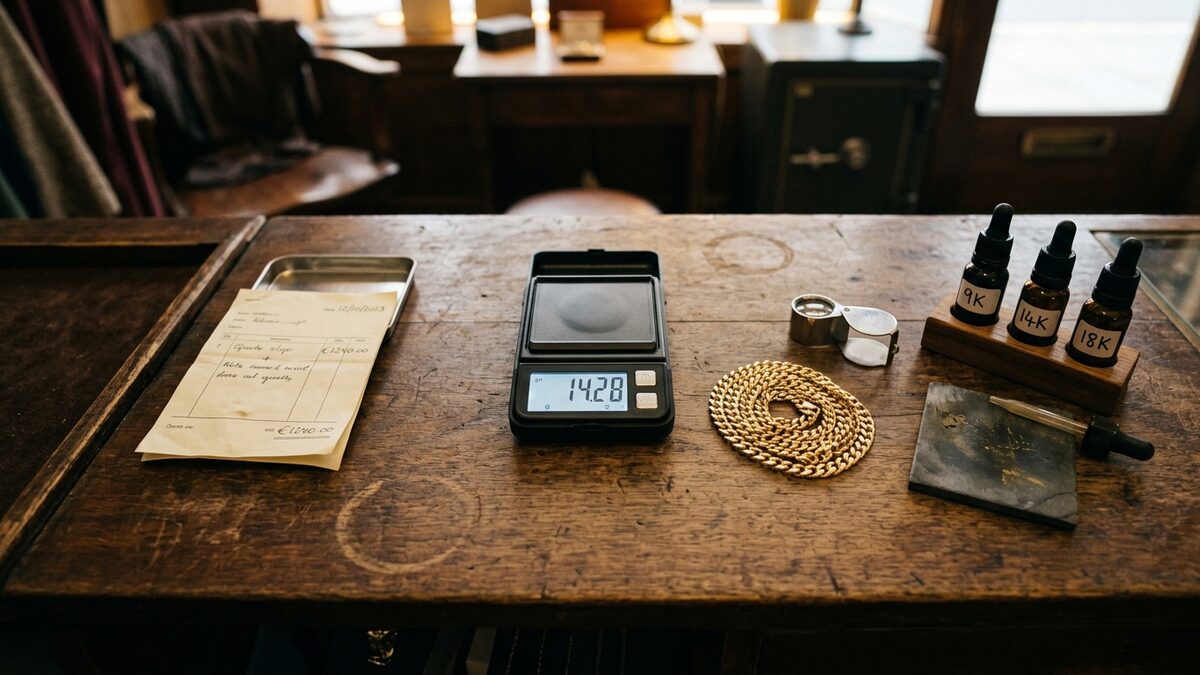
Most sellers walk into a gold buyer with a rough idea of the spot price and a vague hope that the dealer will be fair. The dealer knows this. The gap between what your gold is worth and what you walk out with is almost never about the metal itself; it is about which of these five tactics the buyer leans on hardest. Learn to name them and you stop being the easier mark in the room.
The five tactics below show up in roughly that order of frequency. None of them are illegal. All of them are negotiable once you see them coming.
Tactic one: quoting a percentage of spot without naming the percentage
A dealer says, "I can pay you a great percentage of spot today." That sentence is the tell. A real offer names the number. Sixty percent of spot. Seventy-eight percent of spot. Ninety-two percent of spot. The percentage is the whole offer; everything else is filler.
The counter-move is one question: "What percentage of today's spot are you paying per gram of 14k?" If the dealer pivots to talking about overhead, refining costs, or how the market is moving, you have your answer. A buyer who will not commit to a percentage in plain language is a buyer who plans to adjust the number after they have your gold on the scale.
For reference, a fair payout on common karated jewelry sits in the 75 to 90 percent of spot range for sellers with no relationship, higher with volume. Pawn-style operations often pay 40 to 60 percent and call it generous.
Tactic two: testing karat with acid and quoting low on every piece
Acid testing is legitimate. Acid testing every single piece, then claiming most of them came back as 10k when they are stamped 14k, is a tactic. Stamps are not always accurate, but they are not usually off by four karats either, and certainly not on six pieces in a row.
The counter-move is to ask for an X-ray fluorescence (XRF) test on any piece the dealer claims tested lower than its stamp. XRF gives a percentage breakdown of the alloy and is not subject to the dealer's reading of an acid drop. A buyer with an XRF machine in the shop and an unwillingness to use it is telling you something. A buyer without one, who only offers acid, should be paying you a premium for the uncertainty they are introducing, not a discount.
Tactic three: deducting for solder, clasps, or stones the dealer keeps
A 22-gram chain becomes a "19-gram chain after deductions." The clasp gets called base metal. The solder joints get estimated as a percentage of total weight. Sometimes a small stone is pried out and not returned, or returned in a plastic baggie with no value assigned.
The counter-move is to weigh the piece yourself before you walk in, and to ask the dealer to weigh it in front of you on a certified scale. Then ask, line by line, what is being deducted and why. Solder on a modern chain is usually under two percent of weight; a five percent deduction is a tactic. Clasps stamped with the same karat as the chain are gold and should be paid as gold. Stones the dealer wants to keep should be quoted separately or returned to you.
Tactic four: the verbal quote that drops at the counter
You call ahead. The dealer quotes a strong number over the phone based on what you describe. You drive over. The number drops by 15 percent before the gold is even fully weighed, with a vague reference to "what I'm actually seeing here" or "the market moved this morning."
The counter-move is to get the phone quote in writing before you leave the house. A text message with the karat, estimated weight, and the offered percentage of spot is enough. If the in-person number is lower, the dealer owes you an explanation that is specific to the piece, not the market. Spot does not move 15 percent in the time it takes to drive across town. If the answer is hand-waving, the phone quote was bait.
Tactic five: the "final" offer that is not final
The dealer writes a number on a slip, slides it across the counter, and says it is the best they can do today. You stand up to leave. Before you reach the door, the number goes up by ten or fifteen percent.
The counter-move is to actually leave. Not as a bluff. The number that appears as you walk out is the number the dealer was always willing to pay, which means every dollar above it is also available with one more round of pressure. If you have the time and the gold is not perishable, get a second quote elsewhere and bring the higher number back. Dealers who lead with a lowball are usually willing to match a competing offer; they just prefer to skip that step if you let them.
The pattern underneath all five tactics is the same. The dealer is betting that you do not know the spot price, do not know the karat content, do not know what a fair percentage looks like, and do not have a second quote in your pocket. Show up with all four and most of these tactics evaporate before the conversation starts. The ones that do not evaporate are how you know to leave.