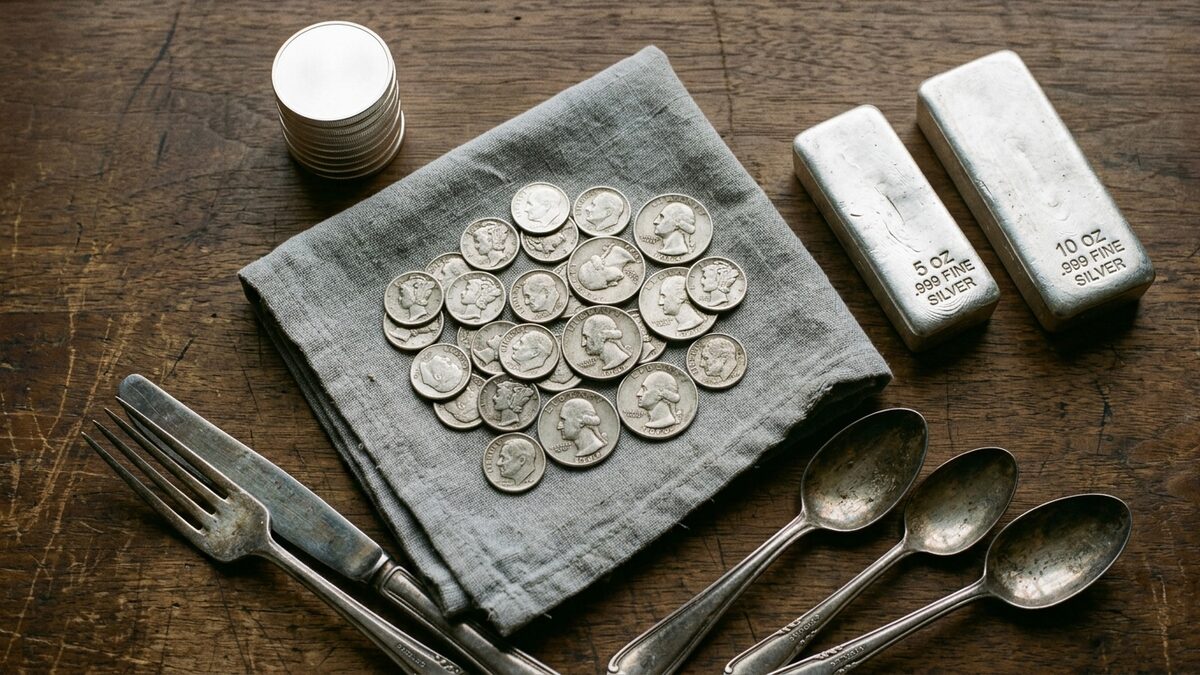
Spot is the wholesale reference for refined silver delivered in commercial quantities. Every dealer payout starts there and then subtracts the cost of getting your specific item back into that wholesale form. The size of that subtraction is the spread, and it varies by product type, condition, and current refiner queue times. A seller who understands the spread walks in with realistic expectations and usually leaves with more money, because they know which items to bring and which to keep.
American Silver Eagles and Canadian Maple Leafs sit closest to spot. These are recognized sovereign coins, sealed or raw, and most dealers move them through other buyers or back into inventory without sending them to a refiner. Payouts on Eagles typically run spot minus $1.50 to spot plus $0.50 per ounce depending on local demand and whether the coin is in an original mint tube. Maples behave similarly. Generic one-ounce rounds from private mints, Sunshine, Scottsdale, SilverTowne, settle lower because they have no resale premium of their own. Expect spot minus $2.00 to spot minus $2.50 per ounce on generic rounds in clean condition.
Bars and junk silver price differently because the refining math is different
Poured and minted bars from recognized brands, Engelhard, Johnson Matthey, PAMP, RCM, hold their own modest premium and pay close to round levels. Off-brand or hand-poured bars get treated as melt and pay spot minus $2.50 to spot minus $3.50, because the dealer has to assay or refine them before resale. Bars over 100 ounces narrow the spread again because the per-ounce refining cost drops sharply at volume.
Pre-1965 U.S. silver coinage, what the trade calls junk silver, prices on a face value multiplier rather than a per-ounce number. A dime contains roughly 0.0715 troy ounces of silver, a quarter 0.1788, a half dollar 0.3575. At a spot price of $32, the silver content of one dollar of face value is about $23.15. Dealer payouts on junk silver typically run 18 to 21 times face value when spot is in the low thirties, which translates to roughly spot minus $2.50 to spot minus $4.00 per ounce of contained silver. The spread is wider than rounds because the coins have to be melted, assayed, and refined before the silver can be sold into the wholesale market. War nickels (1942-1945, 35% silver) and 40% half dollars (1965-1970) pay even lower multipliers because the alloy is harder and more expensive to refine.
Sterling flatware, holloware, and jewelry are the widest spread of all, and the reason is mechanical. Sterling is 92.5% silver, but the remaining 7.5% is copper, and the items often carry solder, stainless knife blades, weighted bases, or hollow handles filled with pitch or cement. A refiner cannot publish an exact yield until the lot is sorted, the non-silver components removed, and the remaining metal melted and assayed. Most dealers buy sterling at 60 to 75 percent of the calculated silver weight value, which works out to spot minus $8 to spot minus $12 per troy ounce of contained silver. Weighted sterling candlesticks and trophy cups pay even less, sometimes a flat per-piece rate, because the actual silver content is a thin shell over a heavy filler.
The spread also moves with the refiner queue. When industrial demand spikes or refiner capacity tightens, the time between a dealer shipping a lot and getting paid stretches from two weeks to six or eight. Dealers price that delay into the offer. The same sterling lot that paid 70 percent of melt in a calm market may pay 62 percent when queues are long, even at the same spot price.
What this means for a seller is practical. Bring the silver Eagles and recognized bars first, because that is where the spread is tightest and a few minutes of price-checking across two or three dealers pays off. Junk silver is straightforward, the multiplier is the multiplier, and any reputable dealer in your area will be within half a point of the others. Sterling is the category where it pays to weigh the lot yourself, calculate the contained silver value at current spot, and then decide whether the dealer offer represents a fair percentage of that number. If a sterling offer comes in below 55 percent of contained silver value at spot, the dealer is either pricing for a long refiner queue or pricing for margin, and a second opinion is worth the drive.