
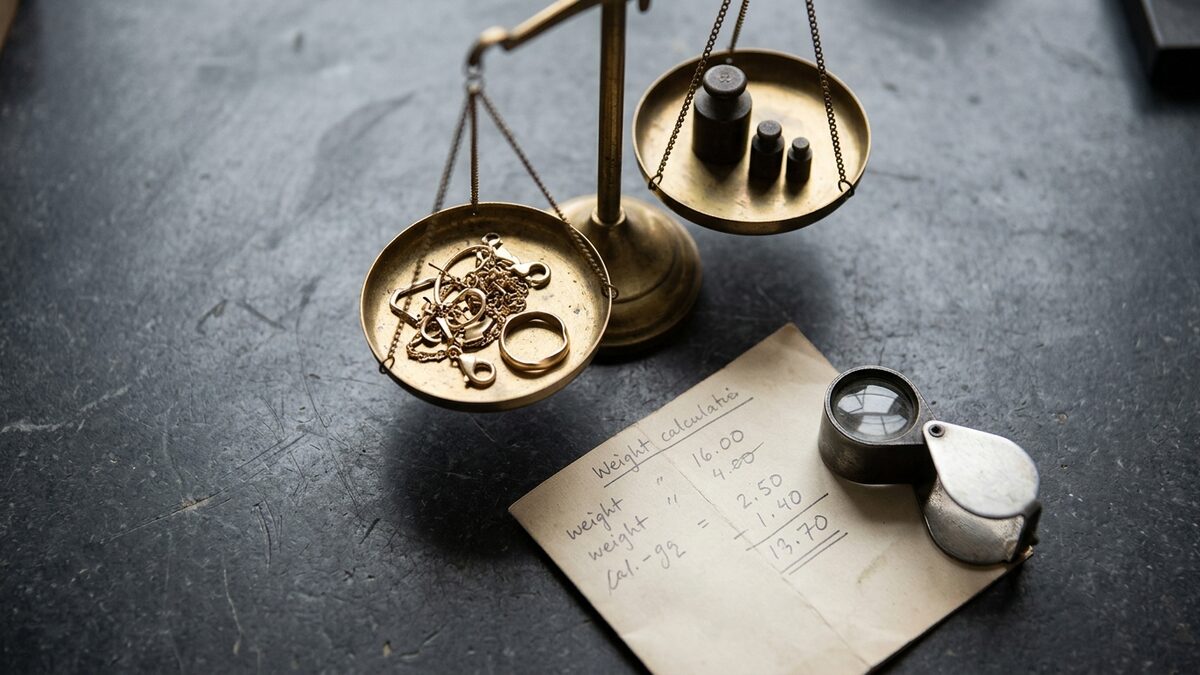
Sellers walk into a gold buyer with a number in their head, usually the spot price they pulled from a finance site that morning. Then the offer comes back lower, sometimes by a wide margin, and the conversation gets tense. The gap is real, it is mostly explainable, and a seller who understands the math walks out with a better deal.
Spot price is the wholesale benchmark for one troy ounce of pure, refined, deliverable gold, traded in million-dollar lots between banks, refiners, and bullion exchanges. It assumes the metal is already 99.99 percent pure, already in the form the market wants (a recognized bar or coin), and already in a vault the buyer trusts. None of those assumptions apply to a wedding band sitting on a counter.
What a dealer is actually buying is scrap. The metal has to be tested, sorted by karat, melted, assayed, and refined back to bullion grade before it can re-enter the wholesale market. Every step has a cost, and every step has a small loss. The payout offered to the seller is spot price minus all of those downstream costs, minus the margin the dealer needs to stay in business.
The karat math nobody explains at the counter
Gold jewelry is almost never pure. The karat stamp tells you what fraction of the piece is actually gold, with the rest being copper, silver, nickel, zinc, or palladium added for hardness and color. The conversions are fixed: 24k is 99.9 percent gold, 22k is 91.6 percent, 18k is 75 percent, 14k is 58.3 percent, and 10k is 41.7 percent. A 14k chain that weighs 20 grams contains roughly 11.7 grams of actual gold. The other 8.3 grams are alloy metals worth pennies.
So the first move on any honest offer is to convert the gross weight to fine gold weight. If spot is sitting at 75 dollars per gram for pure gold, the fine-gold value of that 20 gram 14k chain is about 875 dollars before any deductions. That is the ceiling, the absolute most the metal could ever be worth at that moment. The payout will be lower, and the question is by how much.
Sellers who do this calculation in advance change the dynamic of the conversation. Instead of reacting to a number, they are checking a number against a benchmark they already trust.
Where the rest of the gap comes from
Refining is not free. A refiner charges a treatment fee per batch, takes a small percentage as a refining loss to cover the metal that genuinely vanishes during melting and chemical processing, and pays the dealer slightly under spot for the recovered fine ounces. Stack those costs and the dealer is netting somewhere between 92 and 96 percent of spot on the fine gold weight, before any margin of their own. That alone explains a 4 to 8 percent haircut against the headline number.
Then there is the dealer margin. A storefront has rent, insurance, security, licensing, testing equipment, and staff. An online mail-in service has shipping, insurance, fraud loss, and marketing. Both need a spread between what they pay sellers and what they net from the refiner. On bulk lots from regular suppliers that spread can be tight, two or three percent. On a single walk-in transaction with a piece that needs individual testing, it is usually wider, often 10 to 20 percent on top of the refining costs.
Add it up and a fair offer on a clean 14k piece typically lands somewhere between 70 and 85 percent of the fine-gold spot value on the day. Anything above 85 percent is a strong offer worth taking. Anything below 65 percent is a dealer hoping the seller did not run the math.
How to benchmark an offer in two minutes
Before going to any buyer, weigh the piece on a kitchen scale accurate to 0.1 grams. Note the karat stamp. Pull the current spot price per gram, which is the per-ounce spot divided by 31.1035. Multiply gross weight by the karat purity fraction to get fine gold grams, then multiply by spot per gram. That is the ceiling.
A reasonable payout sits at 75 to 85 percent of that ceiling for 14k and 18k jewelry, slightly higher for 22k and 24k pieces because the refining yield is better, slightly lower for 10k because the alloy fraction is so high that processing costs eat more of the value. Dental gold, broken chain, mismatched earrings, and bent rings all price the same per fine gram as a clean signed piece, because once it hits the melt pot none of that matters. Sellers who think a designer hallmark adds resale value at a scrap buyer are usually disappointed; that premium only exists at a jeweler who plans to resell the piece intact.
Get two or three offers on anything worth more than a few hundred dollars. Dealers know sellers shop around, and a verbal quote costs nothing to give. The quote that sits closest to the ceiling, with the math shown openly on paper, is almost always the right one to take.
When the spot-versus-payout gap is a red flag
The gap should be explainable. A buyer who quotes a flat dollar figure without weighing the piece in front of the seller, without testing the karat, and without referencing the day's spot price is not running a transparent shop. A buyer who refuses to break the offer down into grams, purity, and percentage of spot is hiding the margin because it is too wide to defend. A buyer who pressures a fast decision, especially on a piece the seller brought in just to get an estimate, is counting on urgency to close a weak offer.
The trade has plenty of fair operators and a fair number who are not. The difference shows up in whether the math is on the table. Sellers who walk in with their own numbers already calculated rarely get the worst offers, because the dealer can see immediately that lowballing will not work. That is the entire point of understanding the gap: not to argue with the dealer, but to recognize a fair deal when it is offered and walk away from one that is not.